

Wimberley Texas Is Growing: What It Means for Wimberley Real Estate
Wimberley is going to change. The question is whether it can grow without becoming something entirely different.
I recently attended Wimberley’s State of the City luncheon, hosted by the Wimberley Chamber of Commerce, and one thing really stuck with me:
Wimberley is growing-but it’s being intentional about what that growth looks like.
That matters if you own property here, are thinking about buying a home in Wimberley, or are simply curious about where this little Hill Country town is headed.
Because when you buy a home, you're not just buying the house.
You're buying the roads you drive home on, the parks you spend Saturday mornings in, the trails you walk, the swimming hole you take your visitors to in July, the downtown you wander through-and the character of the community around you.
So when Wimberley starts making decisions about how to grow, I pay attention.
And there is quite a bit happening.
How is Wimberley growing?
Hays County is projected to experience substantial population growth over the coming decades, upwards of 100%+, while Wimberley's population is expected to grow by roughly 32% by 2045. The city currently has a population of about 2,900. Remember though, the city limits are small. Our population is closer to 13,000+ in the whole of the Wimberley Valley.
That sounds like a lot-and it is-but put Wimberley’s growth next to what is happening in places like Dripping Springs, New Braunfels and Canyon Lake, and the difference becomes pretty interesting.
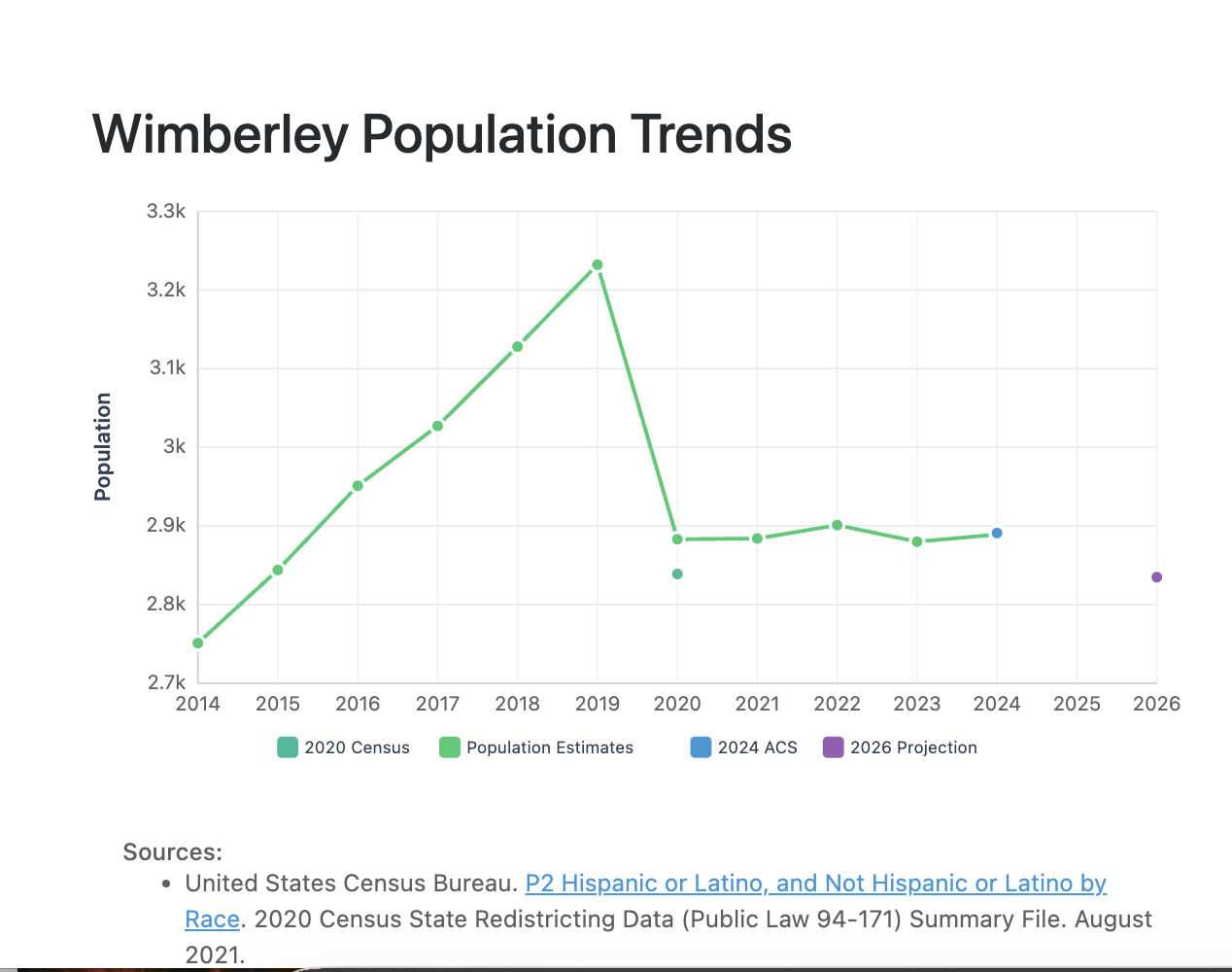
Wimberley’s topography and layout with a lack of as many large roads like 290 or 281 make large-scale development less likely in that same way.
That creates a very different growth equation.
Instead of simply adding more rooftops, Wimberley is also thinking about how to improve the community that already exists.
That includes parks, trails, sidewalks, roads, recreation, environmental education and connectivity.
And to me, that's where the story gets interesting.
What projects are happening in Wimberley?
Some of the most interesting investments aren't necessarily the things you see first when you drive through town.
Wimberley already has some wonderful places to walk and get outside, but there is a bigger conversation happening around how those places connect.
The Wimberley Valley Trails Initiative includes multimodal improvements along Old Kyle Road between RM 3237 and RM 2325/RR 12, including a separated bike lane and a roundabout near the intersection with RM 3237.
The City's Parks & Recreation planning also looks at trail connectivity between parks and natural areas. The existing Cypress Creek Nature Trail, for example, connects the area near downtown with Blue Hole Regional Park.
And I was especially interested to hear about the broader Hays County trail planning and the possibility of connecting Wimberley to other parts of the county through hike-and-bike trails.
We already have some great trails here.
I'm always happy to see more.
But I think the bigger idea is connectivity.
When sidewalks, trails and bike routes become part of how a community functions, it becomes a little easier to enjoy Wimberley without getting in your car for everything.
That's a lifestyle amenity-and lifestyle is a big part of why people choose Wimberley in the first place.
The Blue Hole Nature Center
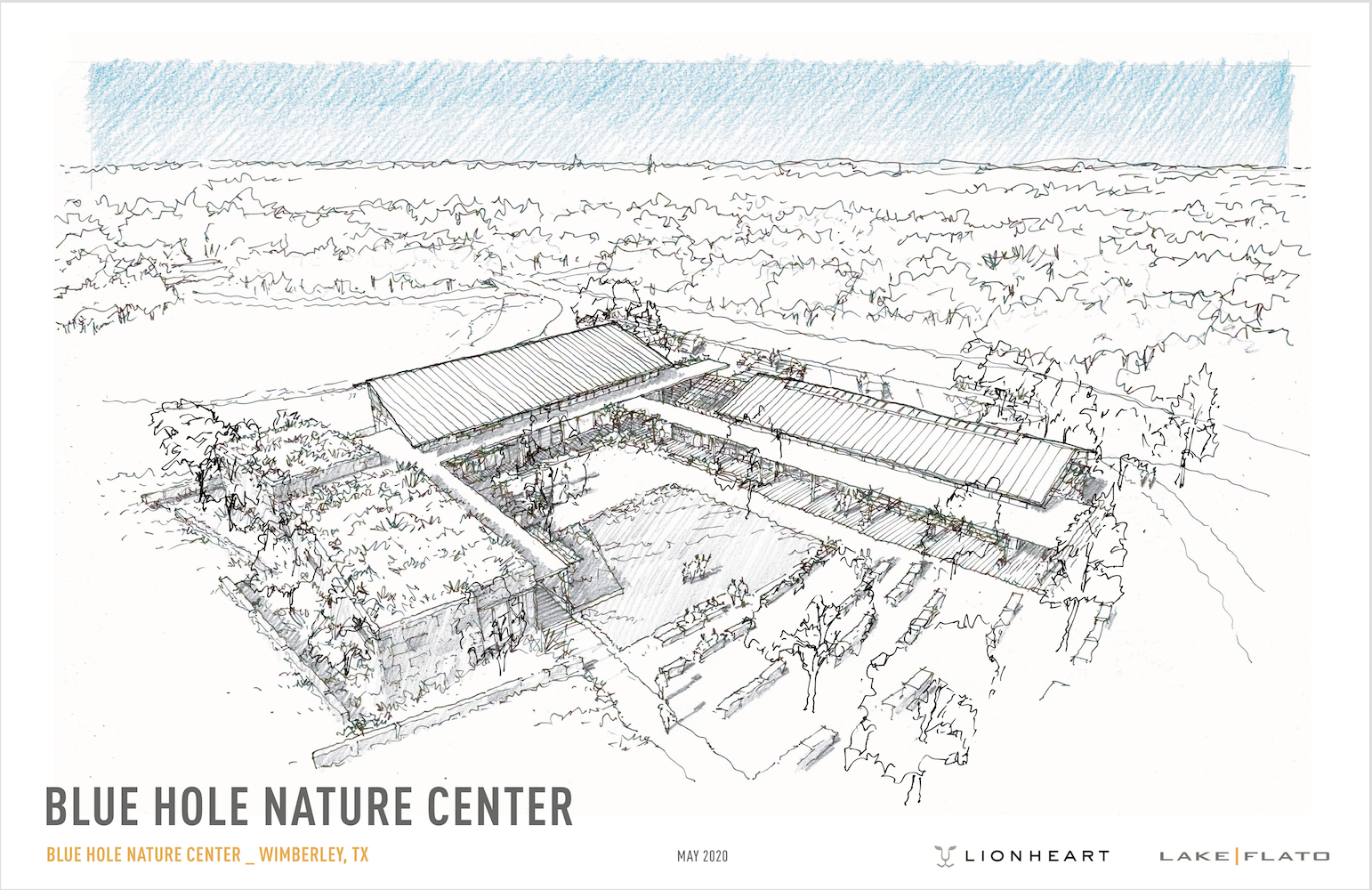
If you know me, you know I have a soft spot for long summer evenings at Blue Hole so the idea that such a fantastic architecture firm as Lake Flato is designing our new environmental education and community gathering center is particularly appealing to me.
The City has been working through a formal architecture and project-management process for the Nature Center. The project is envisioned as a hub for environmental education, sustainable architecture and community engagement, with both indoor and outdoor learning spaces.
And I love that the focus isn't simply on creating another building.
The Blue Hole Nature Center is about teaching people about the ecosystems that make this part of the Hill Country so special.
The water.
The plants.
The wildlife.
The karst limestone.
The relationship between all of it.
That's important because Wimberley's greatest asset isn't something we can manufacture.
It's the natural environment itself.
It seems like the city's Parks & Recreation planning recognizes the importance of protecting and connecting those natural resources, while also creating places where people can experience them.
That feels like a smart way to think about growth.
And then there's the possibility of an aquatic center
The City of Wimberley recently solicited proposals for a feasibility study to determine what aquatic recreation facilities and services might make sense for the community. The study is intended to look at community needs, potential capital and operating costs, environmental and site constraints, and long-term financial sustainability.
So, to be clear, this isn't a finished project yet.
But the possibility of a community aquatic facility is something I'm personally excited about. The idea of adding another place for residents to exercise, swim, gather and build community is interesting because these are the kinds of amenities that don't always show up in a real estate listing but they become part of the reason someone chooses to live somewhere.
What about the tourists?
At the State of the City luncheon, we heard that Wimberley saw approximately 177,000 overnight trips and another 52,000 day trips over the past year, with visitors coming primarily from Houston, Dallas and San Antonio.
That's a remarkable amount of visitor activity for a community this size.
And I think it's worth looking at those numbers a little differently.
It is easy to be annoyed by visitors when you're sitting behind traffic on RR 12. I get it.
But I also think it's important to pay attention to why they're here.
They're coming for the river, the swimming holes, the restaurants and galleries, the music, the shops and the scenery.
The experience of being in a small Hill Country town.Visitor spending generates sales and hotel occupancy tax revenue, which helps support the local economy and the community services and improvements that residents and visitors both use.
The City is even examining the economic role of short-term rentals as part of its recent Short-Term Rental Committee work, which found that short-term rentals contributed an estimated $10.4 million to local gross domestic product in fiscal year 2025. If you want more info on that plus details on the number of units we have click here.
That gives you another indication of just how significant tourism is to a town this size.
There's another big piece of the story: conservation
One of the things I find most encouraging about the future of Wimberley isn't development at all.
It's land being protected. Just west of Wimberley, Hays County is developing the 530-plus-acre Sentinel Peak Preserve as a conservation-focused public natural area.
The preserve includes habitat for the federally listed golden-cheeked warbler and approximately a mile of frontage along the Blanco River. The county plans for low-impact public access, including trails and riverfront recreation, while maintaining conservation and water-resource protections.
That's a pretty remarkable asset and it's another example of why I think the future of Wimberley is worth paying attention to.
Growth doesn't have to mean that every available piece of land becomes housing.
Some of the most valuable investments a community can make are investments in what it chooses not to develop.
So what does all of this have to do with Wimberley real estate?
Quite a bit.
If “location, location, location” ever rang true, it might be here.
Real estate values aren't determined by houses alone. They're shaped by land, supply, demand and the desirability of the place people are buying into.
And Wimberley has a pretty unusual combination of those factors:
Limited housing supply.
A highly desirable Hill Country lifestyle.
Growing regional demand.
A natural environment that is difficult to replicate.
And a community that is investing in the things that make this place special.
That doesn't mean Wimberley property values will rise in a straight line. They won't.
Real estate markets move in cycles. Interest rates change. Buyer demand changes. And as property values rise, the pool of buyers who can afford to participate naturally becomes smaller.
That's important for buyers.
When you're buying a home in Wimberley, you're not simply buying the house.
You're buying into a place with limited supply and a very distinct personality.
Understanding that bigger picture matters.
It's also important for sellers.
Scarcity can absolutely work in your favor, but a smaller buyer pool makes pricing and positioning even more important.
The right buyer may be out there. But your property needs to make sense to that buyer when they're comparing it with everything else available in Wimberley.
What will Wimberley look like in 10 or 20 years?
That's the question I'm most interested in.
I don't think Wimberley can-or should-avoid change.
The region around us is growing. People are moving to the Texas Hill Country. Families are looking for a different pace of life. Businesses are moving here. Visitors are discovering what those of us who live here already know.
Wimberley is going to feel that growth.
The interesting question is whether we can accommodate it while still having the things that make someone drive out RR 12, cross the Blanco River and think:
Yes. This is the place.
That's what I'll be watching.
Because when I think about the future of Wimberley real estate, I'm not just interested in how many houses are sold or what the median price does next year.
I'm interested in what kind of place Wimberley is becoming.
It's where I'm raising my family, and it's a community I love.
And I think the decisions being made now will have a lot to do with what Wimberley feels like-and what owning property here means-10, 20 and 30 years from now.
If you're considering buying or selling in The Hill Country or Wimberley
If you're thinking about buying a home, land or investment property in the Hill Country or Wimberley, I think it's worth looking beyond the individual property.
The community matters.
I'll continue watching the growth, infrastructure, conservation and real estate trends that are shaping Wimberley and sharing what I think they mean for people who live here or are considering making Wimberley home.
Sources & resources
For readers who want to dig deeper, these are some of the primary sources I used:
City of Wimberley — City news, projects, planning and community information.
Wimberley Parks & Recreation Master Plan — The City's 2024–2034 parks and recreation planning document.
Blue Hole Nature Center project information — Current City information on the Nature Center design and project process.
Wimberley Valley Trail project — Hays County information on the Old Kyle Road multimodal project.
Sentinel Peak Preserve — Hays County information on the 530-plus-acre conservation project west of Wimberley.
Wimberley Aquatics Feasibility Study — Current information on the City's study of future aquatic recreation options.